

Best Time to Visit Vietnam: A Region-by-Region Guide
Best Time to Visit Vietnam: A Region-by-Region Guide
Vietnam stretches more than 1,600 km from north to south, so there is no single "best" month for the whole country. While Hanoi shivers in winter drizzle, Ho Chi Minh City can be hot and dry, and the central coast may be in the middle of its rainy season. The good news is that somewhere in Vietnam always has good weather. This guide explains the seasons in each region, month by month, and shows how to plan a route that follows the sunshine – including what to expect if you add Cambodia or Laos to your trip.
At a glance
Whole country
March–May and late September–November
North
Spring and autumn; cool winters
Center
February–August; rain September–December
South
Dry December–April; warm all year
The short answer
For a trip that covers the north, center and south in one go, the most reliable months are March to May and late September to November. Temperatures are pleasant in the north, the south is mostly dry, and the central coast is either just before or just after its heaviest rains. If you can only travel in July or August, you can still have a great trip; simply plan more time in the center, which is at its sunniest in summer. If you are traveling over Christmas and New Year, focus on the south and the islands, where December to April is the dry season.

Understanding Vietnam's three climate zones
The Truong Son mountain range and the long, narrow shape of the country create three distinct weather systems. The north has a subtropical climate with a real winter. The center is shielded from the summer monsoon by the mountains, so it stays dry when the rest of the country is wet, and then receives heavy rain in autumn. The south is tropical, with a dry season and a wet season but hot temperatures all year. Planning a trip around these three zones is the key to good weather.

Northern Vietnam: Hanoi, Halong Bay, Ninh Binh and Sapa
The north has four seasons. Spring (March–April) and autumn (September–November) are the most comfortable, with mild days and clearer skies over Halong Bay. Summer (May–August) is hot and humid, with short, heavy showers and the occasional storm that can delay a cruise. Winter (December–February) is cool and often gray in Hanoi and Halong Bay, with temperatures around 15–20°C, and can be cold in the mountains: Sapa sometimes sees frost and, very occasionally, snow.

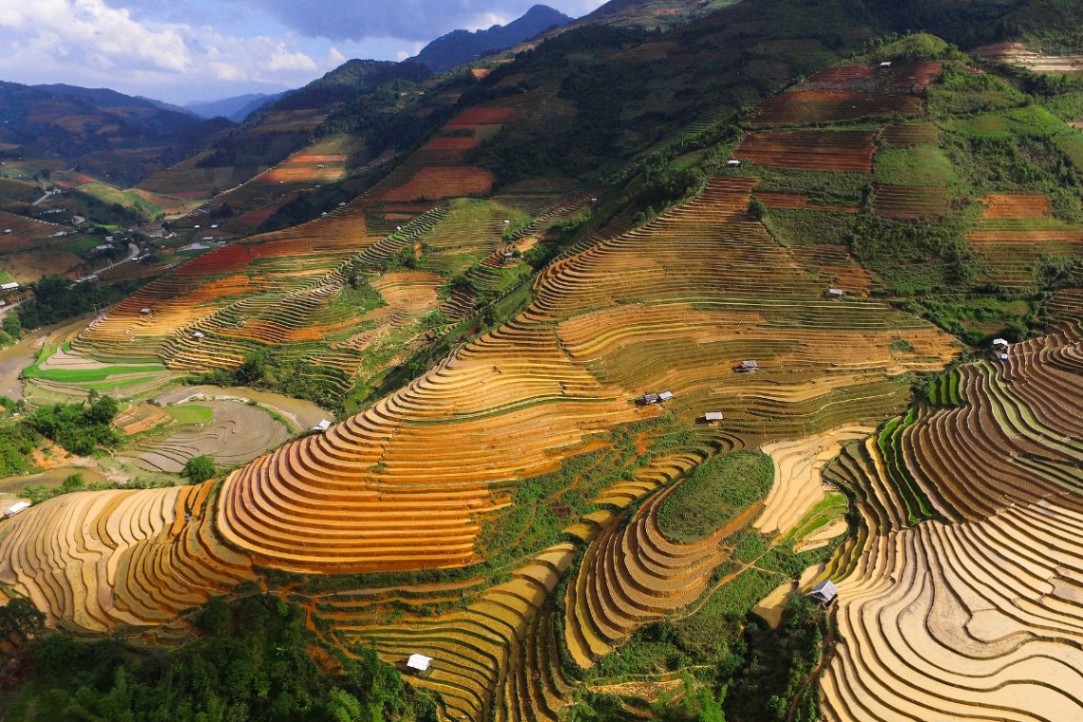
The rice terraces around Sapa and Ha Giang are greenest in June and July and turn golden in September and early October, a favorite time for photographers. The buckwheat flowers of Ha Giang bloom in October and November, painting the hillsides pink and white. Ninh Binh's rice fields are at their most beautiful in late May and early June, just before the harvest. Our 7-day Hanoi, Sapa and Halong Bay tour is at its best in spring and autumn, and the Ha Giang Loop Tour is spectacular from September to November.
Halong Bay and Lan Ha Bay
Cruises run all year. From October to April the sea is calm, but winter mornings can be misty, which some travelers find atmospheric and others find disappointing for photos. From May to September the weather is warm enough to swim and kayak, but tropical storms occasionally lead the authorities to suspend sailings for a day or two. If you travel in summer, keep a spare day in Hanoi after your cruise. Read our comparison of Halong Bay vs Lan Ha Bay to choose the right cruise.
Central Vietnam: Hue, Hoi An and Da Nang
The central coast follows a different pattern. It is dry and sunny from February to August, which makes summer the perfect time for Hoi An and the beaches of Da Nang. Temperatures in June and July often reach 35°C, so plan sightseeing for the early morning and late afternoon. From September to December the region receives most of its rain, and typhoons can bring flooding to Hoi An's Ancient Town, usually in October and November. If you travel in those months, keep your plans flexible and choose a hotel outside the low-lying river area.

Phong Nha-Ke Bang National Park, north of Hue, follows the same pattern: the big caves and adventure tours run mainly from February to August and some close during the autumn floods. The Hoi An, Hue and DMZ tour to Phong Nha is best from February to August. For the coastal cities of Nha Trang and Quy Nhon further south, the dry season extends from January to August.
Southern Vietnam: Ho Chi Minh City, the Mekong Delta and Phu Quoc
The south is warm all year, with daytime temperatures of 30–35°C. The dry season runs from December to April, with sunny days and lower humidity, the best time for Phu Quoc, Con Dao and the islands. March and April are the hottest months. From May to November there are daily showers, usually short and in the afternoon, so sightseeing in Saigon and the Mekong Delta carries on as normal. The Mekong is at its fullest in September and October, when floating villages and flooded forests such as Tra Su look their most dramatic. Find out more in our Mekong Delta travel guide.
Phu Quoc's west coast is calmest from November to April; during the wet season the sea can be rough on the west side, but the east coast is often sheltered. Con Dao is best from March to June, when the sea is clear and calm.

Month-by-month at a glance
| Months | North | Center | South |
|---|---|---|---|
| December – February | Cool, often gray | Rain easing, cool | Dry and sunny – best |
| March – May | Warm and pleasant – best | Dry and sunny – best | Hot, mostly dry |
| June – August | Hot, humid, short storms | Hot and dry – good beach time | Rainy season, short showers |
| September – November | Mild and clear – best | Wettest months, possible typhoons | Rainy, Mekong at its fullest |
Vietnam month by month
January: cool in the north, dry and pleasant in the south. A good month for Saigon, the Mekong Delta and Phu Quoc. Tet sometimes falls at the end of the month.

February: Tet often falls in February. The center begins to dry out, the south is sunny and the north is still cool and drizzly. Book well ahead if you travel around Tet.
March: one of the best months overall. Warm days in Hanoi, dry weather in Hoi An and sunshine in the south.
April: excellent across the country. The south becomes very hot towards the end of the month, and Halong Bay is warm enough for kayaking.
May: hot everywhere. The center is perfect for beaches; the south's rainy season starts with afternoon storms. Rice harvest in Ninh Binh.
June and July: peak summer. The best months for Hoi An, Da Nang and Phong Nha. The north is hot and humid with occasional storms, and the rice terraces of Sapa are bright green.
August: still good for the center. Storms become more frequent in the north, so allow flexibility for cruises.
September: golden rice terraces in the north, cooler evenings in Hanoi. The central coast starts its rainy season towards the end of the month.
October: one of the best months for the north. The center is at risk of typhoons and floods; the Mekong is at its fullest.
November: excellent in the north and improving in the south as the dry season begins. Heavy rain is still possible in Hue and Hoi An.
December: cool in the north, dry and sunny in the south. Popular for Christmas beach holidays in Phu Quoc and Con Dao.
What about Cambodia and Laos?
Cambodia and Laos share a similar pattern to southern Vietnam. The dry season runs from November to April, with the most comfortable temperatures from November to February. March to May is very hot, often above 35°C at Angkor. The rainy season from June to October brings short afternoon storms, green landscapes and fewer visitors at the temples. In Laos, the waterfalls around Luang Prabang are most impressive at the end of the rainy season, while slow boat trips on the Mekong are pleasant from November to March. If you plan a multi-country trip, November to March is the safest window. See our Angkor Wat travel guide, the Luang Prabang travel guide and our Vietnam, Cambodia and Laos itinerary guide for more detail.

Festivals worth planning around
Tet, the Lunar New Year (late January or February), is Vietnam's biggest holiday. The atmosphere is wonderful, but transport and hotels fill up and some shops and restaurants close for several days, so book early. Hoi An's lantern-lit Full Moon Festival takes place every month, and the Mid-Autumn Festival in September or October fills the streets with lanterns and mooncakes. In Laos and Cambodia, the New Year water festivals in mid-April are lively and fun, and the Water Festival in Phnom Penh takes place in October or November.

Crowds and prices
The busiest periods for international travelers are December to March and July to August, when European and North American school holidays fall. Domestic travel peaks around Tet, the 30 April and 2 September public holidays, and the summer months, when Vietnamese families head to the beaches. Hotels and cruises in Halong Bay, Hoi An and Phu Quoc can sell out in these periods, so book three to six months ahead. May, June, September and November offer a good balance of weather, prices and availability.
What to pack by season
- December to February: a warm jacket and layers for Hanoi, Halong Bay and especially Sapa or Ha Giang; light clothing for the south.
- March to May: light, breathable clothing, sun protection and a light rain jacket.
- June to August: very light clothing, a hat, sunscreen, insect repellent and a compact umbrella.
- September to November: layers for the north, waterproofs and sandals for the center.
- All year: modest clothing that covers shoulders and knees for temples and pagodas.
Tours that follow the best weather
Vietnam Itinerary 14 Days: Sapa to the Mekong Deltaideal in spring and autumn.14 days · Private tour · View itinerary → Luxury Vietnam Tour South to North: 14 Daysstarts in the dry south and finishes in the north.14 days · Private tour · View itinerary →
 Vietnam Beach and Cruise Holiday: 10 Daysgreat from February to August, when Da Nang is sunny.10 days · Private tour · View itinerary →
 Phu Quoc Beach Holiday: 4 Days from Saigonbest from November to April.4 days · Private tour · View itinerary →
 Central Vietnam Family Tour: 7 Daysperfect for summer holidays.7 days · Private tour · View itinerary →
 Vietnam, Cambodia and Laos Tour: 19 Daysbest from November to March.19 days · Private tour · View itinerary →
All our tours are private and can start on any date, so we can adjust the route to match the season you travel in.
Halong Bay and Lan Ha Bay cruises
Cruises run all year. From October to April the sea is calmest; from May to September it is warm enough to swim and kayak. These are the cruises we recommend.
 Halong Bay Overnight Cruise: 2 Days on a Boutique BoatPrivate cabin, sunset and sunrise on the bay2 days · Cruise · View itinerary →
 Lan Ha Bay & Halong Bay 5-Star Cruise: 2 Days, 1 NightQuieter lagoons, kayaking and a 5-star cabin2 days · Cruise · View itinerary →
 Lan Ha Bay & Halong Bay 5-Star Cruise: 3 Days, 2 NightsTwo slow nights on the water, with Viet Hai Village3 days · Cruise · View itinerary →
Compare all our Halong Bay and Lan Ha Bay cruises →
Frequently asked questions
What is the best month to visit Vietnam?
March, April, October and November are the best months for a north-to-south trip, with good weather in most regions.
Is it worth visiting Vietnam in the rainy season?
Yes. Showers are usually short, prices are lower and the countryside is green. Just allow some flexibility for Halong Bay cruises in summer and for the central coast in autumn.
When is the typhoon season in Vietnam?
Storms are most likely from around July to November, affecting the north first and the central coast later in the season.
Is Vietnam good for a Christmas holiday?
Yes, if you focus on the south. Saigon, the Mekong Delta, Phu Quoc and Con Dao are dry and sunny in December, while Hanoi is cool and pleasant for sightseeing.
When is the best time to see the rice terraces?
June and July for bright green terraces, and September to early October for the golden harvest in Sapa and Mu Cang Chai.
Plan your private trip with Entdecke Vietnam
Tell us your dates, interests and travel style, and our local team will suggest a private itinerary for you.
Request a quoteRelated guides
Cover photo: Doan Tuan danny_pham93, CC0, via Wikimedia Commons.